
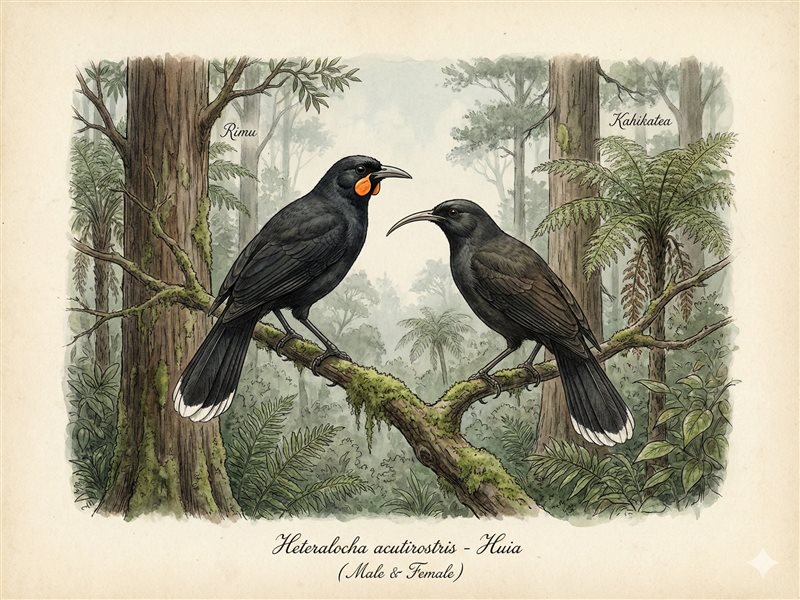
The huia was one of New Zealand’s most remarkable birds – sacred to Maori and unique in the natural world for its extraordinary bill dimorphism.
The huia (Heteralocha acutirostris) was a striking endemic bird of New Zealand that became extinct in the early 20th century. Revered by Maori as tapu (sacred), and prized by European collectors for its beautiful feathers, the huia’s tragic story has become a powerful symbol of conservation in Aotearoa.
Key Facts About the Huia
- Scientific Name: Heteralocha acutirostris
- Family: Callaeidae (New Zealand wattlebirds)
- Status: Extinct (last confirmed sighting 1907)
- Size: 45-55 cm in length
- Distinctive Feature: Most extreme bill dimorphism of any bird species
- Cultural Significance: Tapu (sacred) in Maori culture
A Unique Appearance
The huia was a majestic bird with shiny black plumage, vibrant orange wattles at the base of its bill, and distinctive white-tipped tail feathers. These tail feathers were particularly prized and became symbols of high status in both Maori and European society.
Remarkable Bill Dimorphism
The huia displayed the most extreme sexual bill dimorphism of any bird species in the world. Males had shorter, straight bills for chiselling into decaying wood, while females possessed longer, curved bills for probing deep into crevices. This partnership allowed huia pairs to exploit food sources together that neither could access alone.
When naturalist John Gould first described the huia in 1836, he believed the male and female were two separate species – so dramatic was the difference between their bills.
Sacred to Maori Culture
The huia held a special place in Maori culture and oral tradition. The bird was regarded as tapu (sacred), and the wearing of its skin or feathers was reserved for people of high status – chiefs, warriors, and leaders.
Huia feathers were worn in the hair as a mark of rank and distinction. The practice of wearing these feathers continued for centuries, with strict protocols governing who could wear them and when.
The Waka Huia Tradition
The reverence for the huia extended beyond its feathers. The beautifully carved treasure boxes known as waka huia were named after the bird, reflecting how precious and sacred it was considered. These boxes were used to store taonga (treasures) including huia feathers themselves.
The Path to Extinction
Before human settlement, the huia was widespread across the North Island. Following Maori arrival in the 14th century, the bird’s range began to shrink. By the time Europeans arrived in the 1840s, huia were confined to the Ruahine, Tararua, Rimutaka, and Kaimanawa mountain ranges in the southeastern North Island.
A Perfect Storm of Threats
Several factors combined to drive the huia to extinction:
- Habitat destruction: Forest clearance removed the huia’s native bush habitat
- Introduced predators: Rats, cats, and stoats preyed on eggs and birds
- Hunting pressure: Both Maori and European hunters killed huia in large numbers
- Fashion demand: A European craze for huia feathers fuelled intensive hunting
The Royal Connection
When the Duke of York visited New Zealand in 1901, a Maori guide placed a huia feather in his hatband as a mark of respect. This sparked a fashion craze in England and Europe, dramatically increasing demand for huia feathers and accelerating the bird’s decline.
Too Little, Too Late
The New Zealand government passed legislation to protect the huia in 1892, but enforcement was weak and the law came too late. Scientists proposed relocating huia to predator-free offshore islands, but ironically, collectors found it more profitable to sell captured birds as specimens than to release them for conservation.
The last confirmed sighting of a huia was in 1907, although credible reports suggest a few birds may have persisted into the 1920s. The huia joined the moa, laughing owl, and other species in New Zealand’s tragic catalogue of extinctions.
Legacy and Remembrance
Today, the huia remains one of New Zealand’s most recognised extinct birds. Its image appears on stamps, coins, and artworks, serving as a poignant reminder of what has been lost and why conservation matters.
Bird of the Century
In 2023, the huia received renewed attention during New Zealand’s “Bird of the Century” competition. While the contest was ultimately won by the kakapo (with some controversy), the huia’s inclusion sparked important conversations about ecological grief and the importance of protecting remaining native species.
Huia in Art and Design
The distinctive huia feather pattern – black with white tips – has become an iconic motif in New Zealand art and design. Many contemporary New Zealand artists incorporate huia imagery into their work, keeping the memory of this remarkable bird alive. Artists like Irina Velman and Flox continue to celebrate NZ’s native birds in their distinctive styles.
Explore Maori Culture
Learn more about Maori wisdom and traditions in our guide to Maori Whakatauki and Their Meanings.